The Mothers Between Us
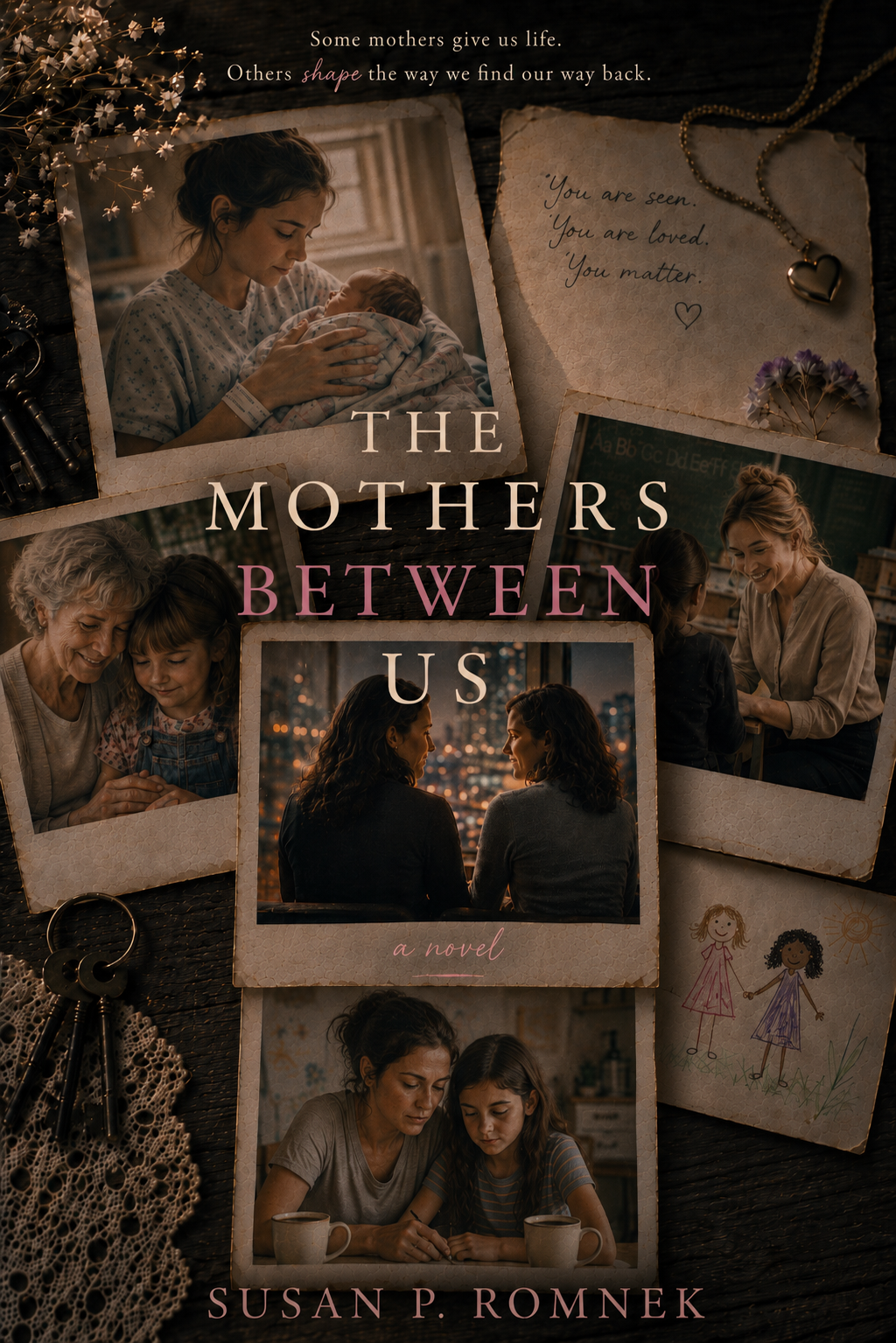
This website is a space for my writing—both the novel I am currently developing and the larger questions that sit behind it.
I write about life as it is lived, not as it is simplified. My work explores trauma, memory, and the lasting influence of the people who shape us—especially family. Some of those influences are loving. Some are harmful. Most are complicated, existing somewhere in between, leaving marks that are not always easy to name.
At the center of my novel is a woman telling her own story, beginning in a childhood shaped by uncertainty, loss, and emotional instability. Her life is not defined by one moment, but by a series of experiences that quietly reshape how she understands safety, love, and identity.
A central thread of the story is a private, one-sided journaling relationship directed toward a teacher from her past—someone who once offered stability and care before suddenly leaving her life. Through writing, she begins to process memory, question meaning, and give language to experiences she has carried for years.
As her life unfolds, the story follows the lasting effects of her choices and the complicated impact of trust, attachment, and emotional connection. At its core is the question of what it means to be truly seen by another person—and how those moments of recognition can shape a life long after they end.
This novel is not only about one life, but about the way all lives are formed through connection—through what is given, what is withheld, and what is never fully understood until much later.
It is about how people shape us, whether they intend to or not.
And it is about what remains when we begin to see those influences clearly for the first time.
Making Plans
While everyone is quickly advancing to all things pumpkin spice and autumn hues, I’m trying to hang in there! Life is unpredictable! Just when I was locked in with a daily routine that was flowing nicely, I developed a stress fracture in the same arm as my shoulder replacement. Fun times! But, people, I am so thankful for my friends who have stepped up to check on me, visit, and take me out. No driving for four weeks…one week down.
I’m still in prep mode for my retreat in October and have rewritten the beginning of my novel. Well, I’m still working on it, but the first ten pages have been delivered for critique from my fellow retreaters.
I’m finding that the one thing I can anticipate with writing is rewriting! It’s a welcome challenge to find the right words to create characters and places that feel real and nurture the mind’s eye. Check out this short excerpt and see if you can identify this anchor institution located in Granville County.
I turned back toward my car and slowly drove up to the parking lot. I got out and stood still, scanning the campus. For a moment, I wasn't sure what I had expected to feel. I had imagined this place so many times that the real thing seemed almost too quiet. The trees moved gently above the sidewalks. Old houses stood among them, their porches and windows softened by years of weather. Cars came and went. Somewhere nearby, I could hear ordinary sounds of people going about their lives.
I stood there as a grown woman, carrying a life the little girl who came here could never have imagined. I had come back on purpose this time. No one had brought me. No one was telling me where I was going or what would happen next. I could leave whenever I wanted. That thought felt bigger than it should have.
Write it, Write it, Write it Again
While it seems fairly straighforward, writing never is simple. I recently took some time off from writing but not from the process (the part of writing that goes on in my head when I can’t sleep). I’m now coming back with a renewed vision. I received a critique of the first part of my book from a published author and college professor. Covering content, strengths, and questions, this critique is precisely what I need. I am now backtracking to use her suggestions to improve and enhance what I’ve already written. This might include a change in point of view, which, while seeming a bit overwhelming, is actually what I felt in my gut. I started out in third person, changed my mind, went to first person, then I was never content with the limited view. I need to get Part I through a second draft in order to submit it to a retreat I’ll be attending in October. I’m excited to be attending a writer’s retreat/workshop in the mountains of North Carolina. This is a step out of my comfort zone, joining other writers from different parts of the country, sharing writing and meals, always falling right down the middle line of my introvert/extrovert, eeny, meeny, miny, moe, will I like people today personality. Here’s to new adventures, a boost of confidence, and the ability to share space with people I don’t know!
The Art of Letter Writing
With stationery sales up more than 30% and interest in letter writing and pen pals increasing by as much as 90%, the United States is experiencing a renewed appreciation for handwritten correspondence. Millennials and Gen Z are leading the trend, choosing to spend less time on screens and seeking more meaningful, personal connections with others. Millennials and Gen Z have also embraced journaling, focusing on mental health, gratitude journaling, goal setting, creative writing, bullet journaling, and memory keeping.
I recently read the novel, The Correspondent, by Virginia Evans, an epistolary novel revolving around letters Sybil Van Antwerp writes to her children, friends, authors, neighbors, former colleagues, and several deeply personal letters that she never sends. I was intrigued by a story made up completely of correspondence.
At the beginning of the novel, Sybil appears to be a woman who has her life under control. By the end, readers realize she has been carrying decades of grief, regret, and love that she has kept carefully hidden. Evans does a remarkable job unveiling the main character.
Part II of The Mothers Between Us is an epistolary section made up of letters Crystal writes to a former teacher. This section of the novel will take us through Crystal’s initial separation from her mother, into her unpredictable, teenage years which are at times tender and at times tumultuous. Part II isn’t just an unveiling of Crystal. It is a testimony of strength and endurance that brings both knowledge and growth to a girl trying to beat the odds.
In this excerpt from a letter to Ms. Gale in Part II, Crystal is sharing the details of her first visit with her mama since being separated from her:
When Emily and I got to the jail, she had to do some paperwork before they would let us go back. A security guard led us to a room that had a table and chairs, some books and magazines, and bottles of water. Emily sat with me while we waited for Mama. She gave me a bottle of water, and offered me a magazine, but I didn’t want either. There were no windows, so I watched the door handle, just waiting to finally see her.
Emily kept looking at her watch. She tried to make small talk, but I just stared at the door and glanced at my list of things to talk about every now and then. I had tried practicing how to say the words, but it didn’t sound natural. I had decided just to read them from the paper.
After about an hour of waiting, someone knocked on the door. After so much anticipation, the head that popped through the door was not Mama’s. A woman asked Emily to step out. The second the door closed, I pressed my ear against it. Voices were mumbled, but the one thing I understood was, “She changed her mind.”
She changed her mind. That had to mean that Mama decided she didn’t want to see me. I turned away from the door before the knot in my throat got any bigger. I will not cry. I will not cry.
Emily came back in.
“Crystal, there’s been a change of plans,” she told me. “Your Mama isn’t going to be able to visit today.” Emily wouldn’t look me in the eye.
I didn’t respond. What was there to say? It’s easy to pretend Mama cares when I’m in a house of strangers who take better care of me than she ever did. I won’t pretend anymore. I don’t want to see her either.
I just want to know why.
Love,
Crystal
All the Mothers
At nineteen, I gave birth to my son. I often laugh and tell people that Ben and I grew up together, but, even in the laughter, I’m serious. I was a child raising a child. The Lord blessed me with this baby to nurture, protect, comfort, teach, and love, and I embraced motherhood wholeheartedly. In the years that followed we welcomed two daughters, Katy and Caroline. These three people who call me Mama have taught me about love, joy, peace, patience, kindness, goodness, faithfulness, gentleness, and self-control. I made mistakes, of course. But I never failed to love them and stand by them through everything. If I could choose to be known for only one thing in this life outside my faith, it would be that I loved my children fiercely.
Yes, yes, so many mothers can relate! There’s nothing like a mother’s love! I’d do anything for my children. My children are my world! But how many read these words and think, not my mother. She wasn’t there to nurture, protect, comfort, teach, and love me.
In the United States, more about 600,000 children will enter foster care each year. That’s roughly 1 in every 200 children at any given time. The most common reasons children are placed in foster care are neglect, parental substance abuse, abuse, and parental incapacity.
Approximately 75% of substantiated cases reported are for neglect. However, experts widely agree that confirmed cases represent only a fraction of actual neglect. Many neglected children are never reported, and many reports are never substantiated despite real concerns. While most neglected children do not appear obviously mistreated from the outside, they may go to school every day, have a home, and still live with profound emotional abandonment or inconsistent care. That's one reason neglect can be so invisible and why stories about it often resonate with readers who recognize pieces of their own childhoods.
For these unidentified children, many mothers stand in the gap: grandmothers, sisters, neighbors, teachers, aunts, foster mothers, adoptive mothers. As a teacher, I know there were many times God called me to stand in the gap. It was a privilege that brought heartbreak.
I must speak to the teachers out there standing in the gap. Thank you. You see more than the statistics of neglect. You see the child who falls asleep in class because of a night with no rest. You hear the longing of a child who just wants someone to notice her or listen to him. You pay for the lunches of a child who never has lunch money and give snacks to the child who never brings one. You buy jackets and underwear and socks and school supplies. You work with children who just can’t catch up academically because there’s no support at home. You sit with children who make one bad choice after another and encourage them and give them hope that success is possible. You see the great potential each child holds within and give them opportunity to shine. You see the child that is too often failed by a system that is overwhelmed. For many of these children, you are the first person who truly sees them. You are making a difference that you might never understand. Continue to stand in the gap.